Sharing does not happen automatically when children receive exciting toy trucks. A shiny dump truck, a sturdy fire engine, or a colorful construction vehicle can quickly become a personal treasure. Adults may need to guide the first exchange gently. This introduction explores How to encourage sharing with toy trucks? It focuses on practical playroom strategies, age-appropriate expectations, and carefully selected trucks that invite cooperation.
The best toy trucks in 2026 should support more than individual driving. Look for durable materials, smooth edges, easy-grip handles, and different roles within one play scene. One child can load the gravel. Another can drive the delivery truck. A third can manage the pretend worksite. Clear roles make sharing feel useful, not forced. Short turns can also help. Use a simple timer or a visible “next driver” card. Keep the language calm and specific: “You had two turns. Now Maya chooses.”
Real play is rarely perfect. A child may refuse, grab, or lose interest. That moment needs patience, not embarrassment. Adults can model trading, waiting, and asking before touching another truck. Experts in early childhood development often recommend realistic expectations, especially for younger children. Sharing grows through repeated practice. It may not appear after one lesson.
The following guide considers truck design, cooperative games, adult modeling, and respectful boundaries. It also examines common mistakes, including buying too many similar trucks or expecting equal sharing every minute. Small details matter: a marked parking space, a cardboard loading ramp, or two workers serving one pretend customer can change the entire play experience.
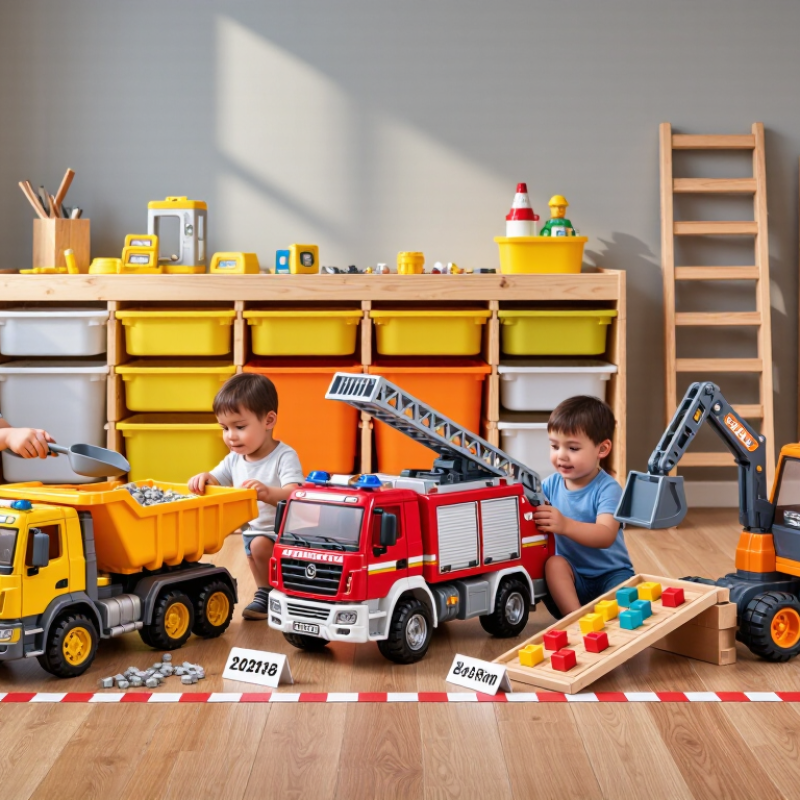
Toy trucks work best for teaching sharing because they create visible, shared missions. Children can deliver blocks, repair a cardboard bridge, or take turns at a loading station. The truck becomes a social tool, not just a possession. In practice, a simple rule helps: one driver, one loader, then switch. Keep the waiting time short. Very short.
The OECD’s 2020 Early Learning and Child Well-being study assessed about 7,000 five-year-olds. It linked home learning activities with stronger social-emotional development. This supports using open-ended truck play with adult guidance. The American Academy of Pediatrics also reports that play develops cooperation, communication, and self-regulation. A truck with two seats or separate cargo tasks encourages negotiation. A single remote-controlled truck may create more conflict. That matters.
Choose trucks with sturdy parts, varied roles, and enough space for several children. Add cones, wooden blocks, and picture cards showing “my turn” and “your turn.” Adults should model sharing without controlling every move. Try saying, “You loaded three blocks; what could your friend carry?” Avoid forcing immediate sharing. Some children need ownership before cooperation. I have seen this approach fail when adults demand equal turns too quickly. The child may comply, but resentment remains. In 2026, the most effective toy truck is not necessarily the largest or fastest. It is the one that makes cooperation easy to see.
| Toy Truck Format | Suggested Age | Recommended Group Size | Shared-Task Opportunities | Turn-Taking Support | Cooperation Rating | Useful Sharing Prompt |
|---|---|---|---|---|---|---|
| Dump Truck | 2–5 years | 2–3 children | Loading, transporting, and unloading materials | 5/5 | 5/5 | “You load while your friend drives. Then switch jobs.” |
| Cement Mixer Truck | 3–6 years | 2–3 children | Collecting, mixing, and delivering pretend materials | 4/5 | 4/5 | “The mixer needs a helper. Who will help first?” |
| Tow Truck | 3–6 years | 2 children | Rescuing, pulling, and guiding another vehicle | 5/5 | 5/5 | “Ask your partner before you pull. Are they ready?” |
| Cargo Truck | 3–7 years | 2–4 children | Sorting, loading, delivering, and unpacking items | 5/5 | 5/5 | “Let’s divide the deliveries so everyone has a job.” |
| Fire or Rescue Truck | 3–7 years | 2–4 children | Planning roles, responding to a scenario, and helping others | 4/5 | 4/5 | “Which role would you like first, and which role can your friend try next?” |
| Truck with Detachable Trailer | 4–8 years | 2–4 children | Connecting parts, planning routes, and transporting larger loads | 4/5 | 4/5 | “One child connects the trailer while another checks the route.” |
Many children manage simple turn-taking around age five. Younger children often need calm adult coaching and repeated practice.
Describe both needs without blaming anyone. Say, “You want the blue truck, and Sam is using it.”
Try a clear two-minute turn. A sand timer makes the change visible and easier to accept.
Give the child a useful job. They can build a road, hold a sign, or choose the next route.
Use one short rule: “We take turns, then we switch.” Keep it visible beside the play area.
Movable parts and open beds create shared jobs. Children can drive, load parcels, plan routes, and repair ramps.
Pause the game and invite three slow breaths. Then ask, “What could make this fair?”
Not immediately. Repair might begin by returning a wheel, rebuilding a ramp, or offering the next turn.
Start with two trucks and one shared mission. Try a cardboard delivery town with three parcels for each child.
Pause and try again tomorrow. Progress can look messy. I sometimes step in too quickly, too.
This guide explains How to encourage sharing with toy trucks? Toy trucks can make cooperation enjoyable because children can work together to build roads, transport pretend cargo, and complete simple group missions. Choosing trucks with durable designs, varied functions, and enough shared accessories can support cooperative play while reducing competition over one favorite toy. Clear, age-appropriate rules help children understand when to share, how to ask for a turn, and why everyone should have a chance to participate.
Through activities such as timed driving turns, team construction, and delivery games, adults can gently introduce sharing and turn-taking. When conflicts arise, caregivers can remain calm, acknowledge each child’s feelings, and guide them toward fair solutions, such as using a timer or assigning different roles. With regular group play, praise for helpful behavior, and consistent reminders, children can gradually develop patience, communication skills, empathy, and lasting habits of sharing.

 Turbo Truck