When a child pushes a toy truck across a rug, play becomes a small movement laboratory. Gripping the cab exercises hand muscles and supports finger coordination. Rolling, stopping, and changing direction invite children to plan movements and adjust pressure. Small actions matter. A truck’s wide wheels may make early success easier, while smaller wheels can demand more control. This simple contrast helps parents notice progress without turning play into a test.
How do toy trucks help with motor skills? The answer includes both fine and gross motor development. Fine motor skills involve grasping, carrying, loading, and placing tiny objects in the truck bed. Gross motor skills appear when children crawl, squat, reach, or walk while pushing a larger vehicle. These actions also connect vision with movement. A child may watch a ramp, predict the truck’s path, and correct it after a bump. That is practical learning.
Evidence from child-development practice supports active, child-led play, but toy trucks are not a cure or a guaranteed milestone. Children develop at different speeds. Caregivers often find that open-ended play reveals more than repeated drills, although observation can be imperfect. Watch how the child holds the truck, crosses surfaces, and responds to frustration. Choose sturdy, age-appropriate toys, avoid small detachable parts for young children, and let the child lead. The following guide examines useful play ideas, realistic benefits, and signs that professional advice may be helpful.
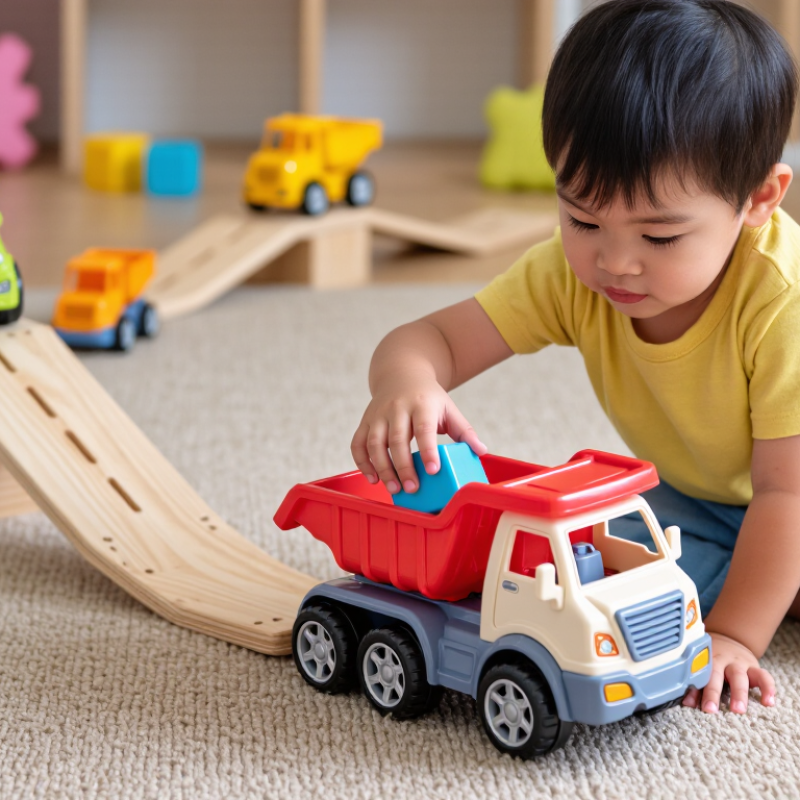
Toy truck play supports several motor skills through simple, repeated actions. Pushing a truck across the floor builds shoulder strength and whole-body coordination. Pulling it with a string encourages balance, timing, and controlled movement. These are gross motor skills. They involve larger muscles in the arms, legs, and trunk.
Small truck play develops fine motor skills too. Children grasp the truck, turn its wheels, and place tiny objects in its bed. These actions strengthen fingers and improve hand-eye coordination. Loading and unloading toys also supports bilateral coordination. One hand can hold the truck while the other adds cargo. Driving around cushions encourages spatial planning and body awareness. A child learns distance through experience, not explanation. Sometimes the truck crashes. That is useful feedback.
Tips: Offer trucks with different sizes and weights. Let children push them on carpet, cardboard, and smooth floors. Create simple routes with pillows or boxes. Ask, “Can the truck fit here?” Avoid correcting every movement. Independent problem-solving matters. Supervise small parts around young children, since safety guidance depends on age and development. Rotate activities when interest fades. I have noticed that children may repeat one route for days, then suddenly try a harder path. Progress is not always obvious. That can make adult expectations too rushed.
Toy truck play can combine fine-motor control, visual-motor coordination, bilateral coordination, and gross-motor movement. The chart counts common play actions linked to each skill area; it is an educational illustration, not a clinical assessment.
How Do Toy Trucks Help With Motor Skills?
Toy trucks can strengthen hand and finger control through simple, repeated actions. A child grips the cab, pushes the wheels, and changes direction with the wrist. Loading small blocks adds a careful pinch between the thumb and index finger. Opening a hinged trailer also requires isolated finger movement and steady pressure. These actions resemble early daily tasks, such as turning pages or using a spoon.
The Centers for Disease Control and Prevention’s 2022 developmental milestone report links toddler progress with actions like turning knobs and using one hand while stabilizing an object with the other. Toy trucks create natural practice for both skills. The World Health Organization’s 2019 guidelines also recommend at least 180 minutes of physical activity daily for children aged three to four. Truck play can contribute to that movement, although it should not replace varied active play.
Adults can make the activity more purposeful. Ask the child to park the truck inside a taped box, carry three blocks, or push it across different surfaces. Watch for a relaxed grip and controlled release. Some children may grip too tightly or avoid smaller pieces. That is useful information, not failure. A truck alone cannot build every fine-motor skill. Quiet drawing, threading, and supervised construction play still matter.
Toy trucks turn simple play into repeated movement practice. A child grips the cab, pushes it forward, and watches the wheels follow a path. These actions connect visual attention with hand movement. They also strengthen small muscles in the fingers, wrists, and forearms.
Driving a truck around a paper road encourages careful steering. The child adjusts pressure when the truck reaches a corner. One hand may guide the vehicle while the other steadies the paper. This supports hand-eye coordination and bilateral coordination. Parking beside a block adds a clear spatial challenge. Is it close enough?
Pushing trucks across carpet, wood, or a low cushion changes the physical effort. Carpet creates resistance, while a smooth floor allows faster movement. Children learn to control force through these differences. Development specialists often describe this as sensory-motor learning, because touch and movement work together. Short routes can also encourage crossing the body’s midline. For example, a child reaches from the left side toward a truck on the right.
Not every play session looks organized. That is normal. A child may crash repeatedly or abandon the route. I would not treat this as failure. The child may be testing speed, balance, or cause and effect. Adults can offer quiet prompts, such as Try a slower push,
without taking control. Small changes matter. A wider road, a heavier load, or a gentle ramp can reveal different coordination skills. Supervision remains important, especially around steps, furniture, and small detachable pieces.
Toy trucks can turn a living room into a small, changing map. When children push a truck around cushions, they judge distance, direction, and available space. That is spatial awareness in action. They notice whether the truck can pass under a chair or around a block. These decisions also support movement planning. Children predict a route, choose a starting point, and adjust when the path fails. Occupational therapy guidance often links active floor play with coordination, visual tracking, and problem-solving. The learning feels natural because the goal is simple: move the truck where it needs to go.
Different surfaces add useful challenges. A rug slows the wheels, while a smooth floor allows faster movement. Children may use one hand, switch hands, or lean closer for control. These small changes strengthen body awareness and hand-eye coordination. However, truck play is not a guaranteed developmental solution. Some children prefer watching, building, or repeating one route. Their play still matters, even when it looks less active. Adults should avoid turning every game into a test.
Tips: Create short routes with pillows, boxes, and safe household objects. Ask, “How can the truck get there?” rather than giving the answer. Let children redesign the path. Keep the space uncluttered and supervise near stairs or furniture. Ten focused minutes may be enough. Observe patience, balance, and planning, not just speed.
Toy trucks can turn ordinary floor play into useful motor practice. Children push, pull, lift, steer, and stop them while learning how their bodies work. These actions support hand strength, wrist control, balance, and coordination. Pediatric occupational therapy guidance often emphasizes repeated, purposeful movement during play. A truck makes repetition feel meaningful rather than demanding.
Create a simple route with cushions, cardboard boxes, and masking-tape lines. Ask the child to drive along the line, climb over a low cushion, and park inside a small “garage.” This encourages visual tracking, controlled movement, and planning. Use different surfaces, such as carpet, tile, or grass, to change the resistance. Keep it simple. Let the child choose the route sometimes.
Add small challenges gradually. The child might load three wooden blocks, pull the truck with a short cord, or carry it between two marked spots. These tasks develop grasping, bilateral coordination, and body awareness. Stay nearby and avoid loose parts that could create a choking risk. I once made a course too difficult, and the child stopped participating. That was a useful reminder: progress needs flexibility, not pressure. If steering remains difficult, try wider paths and larger handles before adding obstacles. Praise careful effort, not only successful parking. Five minutes of focused play can be enough, especially when the child is still learning to control speed.
Toy trucks support gross and fine motor skills through repeated movement. Pushing builds shoulder strength and whole-body coordination. Gripping, steering, and loading strengthen hand control. Progress may look uneven.
Pushing connects visual attention with hand movement. A child watches the wheels while adjusting pressure. Different surfaces change the effort. Carpet feels slow, while smooth floors allow faster movement.
Yes, pulling encourages balance, timing, and controlled movement. The child must walk while guiding the truck behind them. Short paths work well. The string may tangle.
Children grip the cab, turn wheels, and change direction with the wrist. Loading small blocks encourages a pinch using the thumb and index finger. Opening a trailer can require steady finger pressure. Some children grip too tightly.
Loading supports bilateral coordination. One hand can hold the truck while the other places a block inside. Removing each piece adds another controlled movement. Use large pieces for younger children.
Create a road with pillows, boxes, or paper lines. Ask, “Can the truck fit here?” Parking beside a block adds a clear distance challenge. Crashes provide useful feedback.
Try carpet, cardboard, smooth floors, and low cushions. Carpet adds resistance, while a cushion changes balance and force. Narrow roads require careful steering. Wider roads may be better at first.
No. Quiet prompts can support problem-solving without taking control. Try saying, “Use a slower push.” Independent attempts matter, even when the route looks messy. Adults can rush progress.
No. Trucks provide useful practice, but they do not develop every fine-motor skill. Drawing, threading, and supervised construction add different movements. Variety remains important.
Supervise small detachable pieces around young children. Keep routes away from steps and unstable furniture. Choose truck sizes suited to the child’s age and development. Safety needs can differ.
How do toy trucks help with motor skills? Toy truck play gives children a fun way to practice both fine and gross motor abilities. Picking up, holding, loading, and unloading small trucks strengthens hand and finger control, while turning wheels, opening compartments, and arranging objects encourages precise movements. These simple actions can support grasping, releasing, and coordinated use of both hands.
Pushing and driving trucks across different surfaces also improves hand-eye coordination, arm movement, and control of force and direction. As children guide trucks around obstacles, through pathways, or toward specific destinations, they develop spatial awareness and learn to plan movements in advance. Adults can encourage growth by providing open-ended play opportunities, adding safe obstacles, creating simple routes, and inviting children to sort, stack, or transport objects. Through repeated, imaginative play, toy trucks can help build confidence, coordination, balance, and purposeful movement.

Turbo Truck