Toy trucks can make sensory play feel purposeful without turning a room into a complicated activity station. Their rolling wheels, textured tires, sturdy bodies, and varied colors invite children to push, sort, scoop, and describe what they notice. China’s toy market includes many styles, from small dump trucks to larger construction vehicles, but a bright finish alone does not make a truck a good choice. Check the stated age range, look for loose parts or rough edges, and choose a size that suits the child and play space. Keep it simple.
How to use toy trucks for sensory play? Try a shallow tray of damp sand, where a dump truck can carry small loads from one corner to another. For younger children, use larger, easy-to-clean materials and avoid small loose fillers that could pose a choking risk. Water play can add a different sensation: children might roll a truck through a thin layer of water, then compare its wet tracks with dry ones. Stay nearby, especially around water, and follow the toy’s care instructions. Expect a little mess. These activities can encourage descriptive language and hand movements, though every child responds differently. Some may prefer watching before joining in, and that is worth respecting. This guide explores useful truck features, simple sensory setups, and practical ways to keep play engaging, comfortable, and age-appropriate.
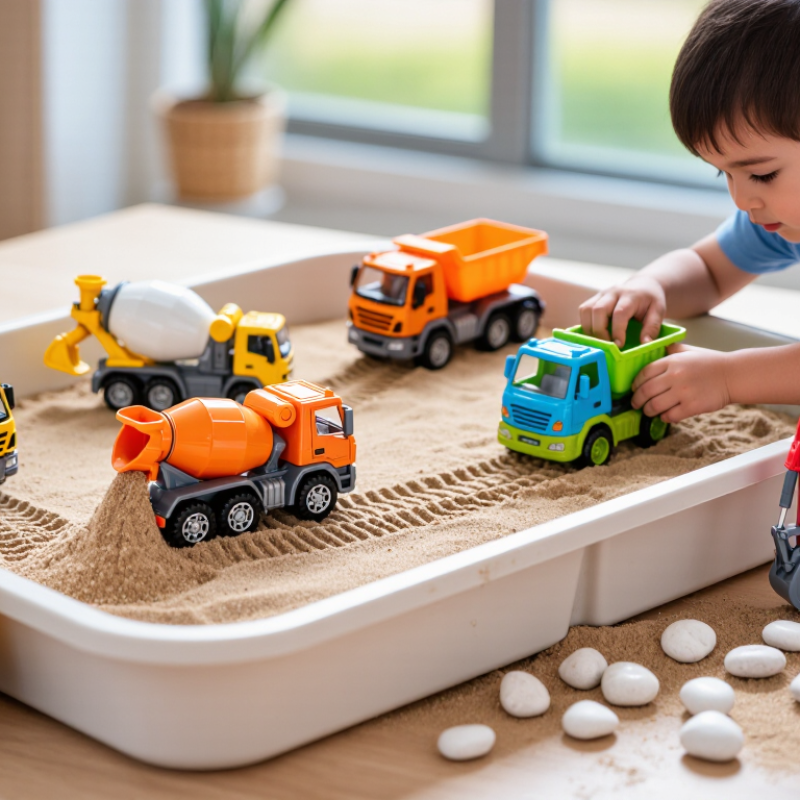
A useful sensory truck offers more than bright paint. Check for contrasting colors, ridged tires, smooth panels, and parts that move with a gentle push. These features give children clear things to notice: rough against smooth, quiet against rattling, still against rolling. Let the child lead. Ask, “What do you hear?” or “Which wheel feels different?” Then pause; adults can sometimes ask too many questions.
The American Academy of Pediatrics’ 2018 clinical report, “The Power of Play,” describes play as supporting children’s development and relationships. Use the truck for simple experiments: roll it over carpet, then a hard floor, and compare the sound and distance. Keep the volume comfortable, and stop if a sound bothers the child. A 2023 U.S. Consumer Product Safety Commission report estimated 209,500 toy-related emergency-room injuries among children 14 and younger. That figure covers toys broadly, not sensory trucks specifically, but it reinforces the value of checking wheels, fasteners, and detachable pieces before play. Sensory needs vary. A texture that delights one child may distract another.
A sensory-play truck should invite gripping, rolling, and gentle bumping—not expose sharp edges or loose parts. For toys intended for children, ASTM F963-23 covers hazards such as small parts, mechanical strength, and accessible edges. In the United States, the standard is incorporated into federal toy-safety rules. CPSIA also limits lead to 100 parts per million in accessible substrate materials and 90 ppm in paint and similar surface coatings. Ask suppliers for the applicable test reports, a Children’s Product Certificate, and batch-level traceability. A certificate alone is not proof that every production run was tested.
CPSC’s 2023 Toy-Related Deaths and Injuries report estimated 209,500 toy-related emergency-room injuries in the United States during 2022. That figure covers toys broadly, but it is a useful reminder to inspect trucks before play. Check wheels, axles, handles, and painted surfaces; repeat the checks after drops or heavy use. For toddlers, confirm age grading and small-parts test results rather than relying on appearance. A smooth, chunky truck can still have a weak axle. Sensory play gets messy, too: saliva and repeated washing may reveal coating problems that a brief showroom inspection misses. Real-world checks matter.
China-made toys intended for sale in the United States are subject to the same applicable U.S. toy-safety requirements as toys made elsewhere. A country of manufacture, product description, or sensory-play feature does not establish compliance; assessment requires product-specific testing and documentation.
| Comparison dimension | Sensory-play use or feature | Relevant U.S. safety requirement | What to verify for an individual truck |
|---|---|---|---|
| Rolling and pushing | Pushing a truck along a clear, smooth surface can offer a simple movement-and-resistance play activity. | ASTM F963-23 includes applicable mechanical and physical safety requirements for toys. It is incorporated into the U.S. mandatory toy-safety rule at 16 CFR part 1250. | Check the assembled toy, wheels, axles, and attachments for applicable hazards such as accessible sharp edges or points, and confirm that required testing covers the finished product. |
| Small parts and age grading | A larger, one-piece-style truck may be easier to handle, but its size alone does not establish that it is suitable for every age. | CPSC small-parts rules restrict small parts in toys intended for children under 3. ASTM F963-23 also contains age-related requirements and warnings where applicable. | Verify the intended age, applicable small-parts assessment, and warnings. Check detachable wheels, decorative pieces, and accessories rather than judging only the truck body. |
| Surface texture and handling | Ridges, smooth panels, or molded details provide different tactile surfaces for supervised exploration. | The applicable ASTM F963-23 mechanical, physical, and labeling provisions depend on the toy’s design, materials, and intended age group. | Inspect accessible surfaces for damage, burrs, or loose parts. Do not assume a textured or smooth finish indicates safety or regulatory compliance. |
| Paints, coatings, and accessible components | Color and contrasting finishes can support visual sorting or matching activities. | CPSIA limits lead in paint or similar surface coatings to 90 ppm and total lead content in accessible children’s-product components to 100 ppm, subject to applicable rules and exceptions. | Request applicable test reports for the actual coatings and accessible materials. Appearance, color, or a supplier statement alone cannot confirm lead compliance. |
| Plastic and flexible materials | Different material finishes may make a truck feel distinct during supervised touch-and-compare play. | CPSIA Section 108 restricts specified phthalates above 0.1% (1,000 ppm) in accessible parts of applicable children’s toys and child-care articles. | Confirm that testing addresses the accessible materials and the phthalates applicable to the product. Material type or country of manufacture does not by itself establish compliance. |
| Moving or detachable features | Rotating wheels or movable parts can add cause-and-effect play when used as intended. | ASTM F963-23 requirements may apply to mechanical hazards, use and abuse testing, and toy construction, depending on the product and its age grading. | Review product-specific test results and instructions. Check for loose or damaged parts before use and discontinue use if the toy becomes damaged. |
| Testing and certification records | Play features describe how a truck may be used; they are not evidence that it has passed safety testing. | For applicable children’s products, CPSIA requires testing by a CPSC-accepted third-party laboratory and a Children’s Product Certificate (CPC) issued by the manufacturer or importer, based on applicable rules. | Check that reports identify the tested product and cover applicable requirements. Confirm the CPC and supporting records are available; do not infer compliance from a generic certificate or listing. |
| Traceability and labels | Clear age and use information helps caregivers select and supervise an appropriate play activity. | CPSIA tracking-label provisions generally require identifying information on children’s products and packaging to the extent practicable. Applicable toy standards may also require warnings or instructions. | Review the product and packaging for applicable age grading, warnings, instructions, and traceability information. Requirements vary with the product and intended use. |
Important: This comparison is general information, not a product certification or legal determination. ASTM F963-23 and CPSIA obligations depend on the specific toy, its materials, design, intended age, and applicable rules. Confirm current requirements and product-specific documentation before purchase or sale.
Sensory play with toy trucks can feel simple: roll a textured vehicle through dry rice, press its tires into play dough, or push it along a towel road. For children under three, check small parts before play. The CPSC small-parts cylinder measures 1.25 inches across and 2.25 inches deep. If a loose part fits completely inside, it may pose a choking hazard. Keep that part away from young children.
Check wheels, mirrors, axles, and detachable accessories, especially after rough play. Use the cylinder only as an adult screening tool; it is not a toy or a complete safety test. Follow the truck’s age label and inspect for cracks, loose pieces, or sharp edges. If a component feels wobbly, set the vehicle aside. Small details matter.
Then offer supervised, age-appropriate sensory play with larger, firmly attached features. A truck can leave tracks in dough or carry large fabric squares across a shallow tray. Keep the play area uncluttered, and stay within reach. I would not rely on appearance alone; a tiny part can look harmless. Check again after play, since repeated drops and washing can loosen components.
Place a toy truck on a clear mat with a shallow basket of large, lightweight objects nearby. Wooden blocks, fabric squares, and chunky foam shapes offer different textures and weights. Keep the play area uncluttered so children can focus on one action at a time. Stay close, and choose objects that are safe for the child’s age.
Loading gives small hands a reason to grasp, lift, and release. Invite the child to fill the truck, then notice which objects fit and which make the bed feel heavy. Push the loaded truck along a short path, over a folded towel, or around a cushion. The change in resistance can prompt useful comparisons: empty trucks roll differently. Sorting can come next. Ask the child to unload objects into groups by color, texture, or size. There is no need to insist on a “right” system.
Some children will repeat one action and ignore the others. That is still meaningful play. It can be tempting to keep adding instructions, but a quiet pause may give the child room to invent a new route or sorting rule. I’d watch for frustration, too; a truck that tips often may need fewer objects or a smoother path. Keep pieces large enough to avoid choking risks, and supervise play throughout.
At 18 months, many children walk independently, try using a spoon, and follow a simple one-step request. Set a large, easy-to-grip toy truck on a clear floor. Ask your child to “push it to the cushion,” then let them walk after it and push again. The rolling wheels add movement and sound. Pause if either seems uncomfortable, and keep small loose parts out of reach.
At 2 years, many children run, kick a ball, and begin combining two words. Make a short delivery route with a soft ball as cargo: load it, drive to a box, and invite your child to kick it at the finish. Model phrases like “truck goes” without requiring repetition.
By 3, many children can take part in a short back-and-forth conversation and draw a circle after seeing one. Ask where the truck should go, then draw a road together with chunky crayons. Let your child choose the route. Play may get messy; that is okay.
Tips: Stay nearby, use a truck suited to your child’s age, and keep play areas clear. CDC milestones are guides, not a pass-or-fail test. If you have concerns about your child’s development, discuss them with a healthcare professional.
Use an adult screening cylinder measuring 1.25 inches wide and 2.25 inches deep. If a loose part fits fully inside, keep it away from children under three. This is only a screening tool, not a complete safety test.
Check wheels, mirrors, axles, and detachable accessories, especially after rough play. Look for cracks, sharp edges, or pieces that wobble. Set the truck aside if anything feels loose.
No. Keep it out of children’s reach and use it only for adult screening. Follow the truck’s age label, too.
Choose a truck suited to your child’s age, with larger, firmly attached features. Keep the play area clear and stay close enough to intervene. Check the truck again after play.
Place a large, easy-to-grip truck on a clear floor. Ask your child to push it to a cushion, then let them walk after it. Pause if the movement or sound seems uncomfortable.
Put a soft ball in the truck as cargo. Drive it to a box, then invite your child to kick the ball toward a finish point. You can model “truck goes” without asking for a repeat.
Ask where the truck should go, then draw a road together with chunky crayons. Let your child pick the route. It may get messy.
No. They are general guides, and children develop at different paces. If you have concerns, discuss them with a healthcare professional. I still think it’s worth checking in; it can be hard to judge alone.
How to use toy trucks for sensory play? Start by choosing trucks with varied textures, clear colors, gentle sounds, and easy-to-notice movement. Invite children to explore how each truck feels and moves, then build simple play around three actions: load objects into the truck, push it along a safe surface, and sort objects by color, size, or texture. Keep materials age-appropriate and supervise play, especially when small objects are involved.
Before play, check product labeling, construction, and age guidance, and compare relevant safety information with ASTM F963-23 and CPSIA requirements. For children under three, screen toys and play materials for small parts using the CPSC’s 1.25 × 2.25-inch small-parts cylinder; this is a screening aid, not a substitute for choosing age-appropriate products. Adjust activities to children’s abilities: at 18 months, offer simple pushing and loading; around age two, introduce basic sorting; by age three, encourage more involved grouping, turn-taking, and imaginative routes.

Turbo Truck