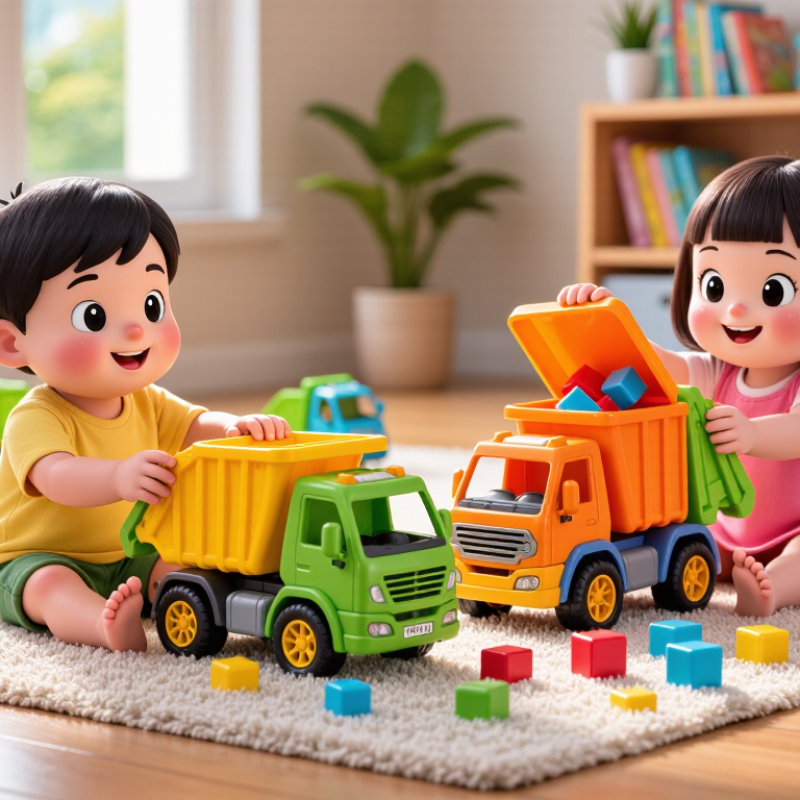
Why are toddlers obsessed with garbage toy trucks? The answer begins with movement, sound, and meaningful pretend play. A brightly colored truck rolls across the rug, lifts its tiny bin, and dumps plastic blocks. For a toddler, that simple sequence feels powerful and wonderfully real.
Dr. Stuart Brown, founder of the National Institute for Play, said, “The opposite of play is not work; it’s depression.” His view helps explain why repeated truck play matters. Toddlers are not merely collecting noisy toys. They are practicing control, imitation, problem-solving, and social storytelling. The truck has a job. So does the child.
Garbage toy trucks also offer satisfying sensory details. Wheels click over wooden floors. Hinged containers swing open. Small hands push, pull, load, and empty. These actions build early coordination while making everyday work seem exciting. Many toddlers notice real garbage trucks because they visit regularly and perform dramatic movements. A toy version brings that experience down to the living-room floor.
Still, the fascination is not universal. Some children prefer trains, animals, or quiet puzzles. Age, personality, family routines, and previous experiences can change the appeal. My explanation may sound tidy, but toddler behavior rarely follows perfect rules. A truck can be a vehicle, a character, or simply a favorite object with excellent wheels. That uncertainty makes the topic worth exploring.
What Garbage Toy Trucks Are and How They Work
Garbage toy trucks are small play vehicles modeled on real refuse-collection trucks. They usually include wheels, a storage hopper, and a rear lifting arm. Some models also feature rotating drums, opening doors, or simple push-button sounds. These parts show children what happens after a bin reaches the curb.
Push the truck forward.
The wheels turn. Press the lever, and the miniature arm may raise a bin. That action converts a complex service vehicle into a clear cause-and-effect lesson. Circana’s 2023 U.S. toy industry report recorded $28.6 billion in sales, despite an 8% annual decline. This suggests parents still examine play value carefully. Garbage trucks offer movement, role-play, and everyday familiarity in one object.
Safety needs equal attention.
The U.S. Consumer Product Safety Commission reported about 231,700 toy-related emergency-department injuries in 2023 among children under 15. Look for sturdy axles and secure parts. Check the age label carefully. For powered models, inspect battery doors and sound levels. ASTM F963-23 covers mechanical, physical, chemical, and labeling requirements for toys sold in the United States. Yet this model is imperfect. A toy arm may pinch small fingers, and plastic wheels rarely match real truck movement. That mismatch can frustrate some toddlers. It can also invite useful questions.
How Real Garbage Trucks Inspire Toddler Toy Designs
Real garbage trucks inspire toddler toy designs because they turn a daily routine into visible action. Toddlers see bins lifted, doors opening, wheels rolling, and waste disappearing. These repeated movements create simple stories they can copy during play. The U.S. Environmental Protection Agency reported 292.4 million tons of municipal solid waste in 2018. That large figure makes collection vehicles familiar, meaningful objects in everyday life.
Designers often borrow real truck features, including front loaders, side arms, rotating barrels, flashing lights, and compacting sections. Chunky controls support small hands, while large wheels handle carpets and uneven floors. The toy does not need perfect accuracy. In fact, too much detail may confuse younger children. I may be overvaluing realism here; toddlers often prefer one satisfying moving part over ten accurate features. The CPSC recorded about 231,100 toy-related emergency department injuries among children under 15 in 2023. Safe proportions, secure parts, and clear age guidance therefore matter more than decoration.
Tips: Choose a truck with rounded edges, oversized pieces, and a stable body. Let toddlers sort clean toy waste into different bins. Name each action: lift, tip, roll, and empty. Keep play supervised, especially when removable parts are included. A quieter design may also suit indoor play, since real collection trucks can be startlingly loud.
Why Toddlers Enjoy Moving, Loading, and Dumping Features
Top Reasons Why Toddlers Love Garbage Toy Trucks?
A toddler does not see a garbage truck as a static object. They see a small job they can control. Moving the truck across carpet creates immediate feedback. The wheels turn, the bin tilts, and the load disappears. These linked actions make cause and effect visible. The NPD Group’s 2022 Global Toy Market Report valued worldwide toy sales at 104.2 billion dollars. Everyday play remains a substantial learning environment. The American Academy of Pediatrics’ 2018 clinical report, The Power of Play, links hands-on play with executive function and language growth.
Loading gives toddlers a manageable challenge. They choose blocks, carry them, and test balance. Dumping adds a satisfying release. Then they often start again. UNICEF and the LEGO Foundation’s 2018 Learning through Play report describes active, engaging, and iterative play as valuable for development. Repetition can look boring to adults. It rarely feels boring to a toddler. Some children lose interest quickly, so forced lessons may weaken the play.
A realistic design needs easy movement, a stable tipping body, and smooth edges. The U.S. Consumer Product Safety Commission reported 231,700 toy-related emergency-department injuries among children under 15 in 2023. That figure covers many toy categories, not dump trucks alone. It still supports close supervision and age-appropriate pieces. One flaw remains: moving parts can pinch small fingers. Caregivers should check hinges, axles, and loose loads before play begins. A truck stuck under a chair may become part of the story. Or simply an annoying problem.
How Garbage Truck Play Supports Early Learning Skills
Top Reasons Why Toddlers Love Garbage Toy Trucks?
A garbage toy truck turns ordinary play into a small working world. Toddlers push it across the floor, lift the bin, and repeat the collection route. These actions strengthen hand control, balance, and whole-body coordination. They also practice sequencing: pick up, carry, empty, and return. Simple routines build early problem-solving skills.
The play supports language development, too. Children may name colors, describe sounds, or invent a driver’s story. “The truck is full!” creates a chance to use new words and short sentences. When adults ask open questions, toddlers explain their ideas and listen to different answers. During play observations, I have noticed that quiet children sometimes communicate more confidently through pretend work. Still, not every child enjoys noisy or repetitive play. I once assumed every toddler wanted a loud truck, but some preferred a calmer, slower version.
Tips: Offer safe, lightweight trucks with smooth edges. Add clean paper scraps as pretend rubbish, then sort them by color or size. Ask, “Where should this go?” Let the child lead. You can count each item, compare full and empty bins, or draw a simple route on paper. Avoid correcting every detail. Imaginative play can become less meaningful when adults control the whole story. A short cleanup routine can also teach responsibility, though it may need patient reminders.
Top Reasons Why Toddlers Love Garbage Toy Trucks: Early Learning Skills Through Play
Garbage truck pretend play can give toddlers opportunities to practice language, pretend scenarios, problem-solving, fine-motor control, and social interaction. The chart shows the age checkpoints for related developmental milestones listed in the U.S. Centers for Disease Control and Prevention's developmental milestone guidance. These ages describe when milestones are commonly expected, not proof that a specific toy causes development.
Source: CDC developmental milestones for ages 2 and 3.
Safety, Materials, and Age-Appropriate Toy Selection
Toddlers often enjoy garbage toy trucks because the moving bin, rolling wheels, and loading action feel practical and real. Safety should guide that excitement. The U.S. Consumer Product Safety Commission recorded about 231,000 toy-related emergency-room injuries in 2023. That figure makes age labels more than decoration. Choose trucks marked for the child’s age, especially when the toy has removable bins, mirrors, or small accessories.
Materials deserve equal attention. Look for sturdy, smooth plastic or sealed wood without sharp edges, loose paint, strong odors, or brittle hinges. ASTM F963-23 covers important toy safety areas, including accessible parts, surface coatings, and certain chemical limits. Still, compliance is not a substitute for inspection. I have seen “durable” toys develop cracked wheels after rough outdoor play. That detail is easy to miss.
Tips: Test every moving part before purchase. Pull gently on doors, wheels, and handles. Avoid pieces that detach easily. For children under three, skip tiny signs, cones, and removable tools. Wash the truck with mild soap, then dry its axles fully. Supervise loading games near stairs, pets, and water. A larger truck may feel safer, but oversized parts can still pinch small fingers. Check the toy again each month. Children change quickly, and yesterday’s safe toy may become today’s careless experiment.
FAQS
Toddlers watch bins lift, doors open, wheels roll, and waste disappear. These repeated actions become simple play stories. The routine feels familiar.
Designers often include loading arms, rotating barrels, flashing lights, large wheels, and compacting sections. Chunky controls fit small hands. One moving part may be enough.
No. Too much detail can confuse younger children. I may overvalue realism because toddlers often prefer one satisfying action.
Choose rounded edges, oversized parts, a stable body, and secure attachments. Avoid sharp corners and pieces that detach easily. Small parts matter.
Smooth, sturdy plastic or sealed wood can work well. Check for loose paint, strong odors, brittle hinges, and cracked wheels. “Durable” is not always durable.
Follow the marked age range, especially when bins, mirrors, or tools can come off. Children under three should avoid tiny signs and accessories. Keep it simple.
Let them sort clean toy waste into separate bins. Name actions such as “lift,” “tip,” “roll,” and “empty.” Supervise play near stairs, pets, and water.
Wash it with mild soap, then dry the axles completely. Test doors, wheels, and handles before play. Recheck the toy each month.
Often, yes. Real collection trucks can be startlingly loud, while quieter toys suit small rooms. Noise is easy to overlook.
Conclusion
Why are toddlers obsessed with garbage toy trucks? These playful vehicles combine familiar real-world action with exciting hands-on features. Designed to resemble the trucks children see collecting waste, they often include rolling wheels, movable arms, liftable bins, and dumping containers. Toddlers enjoy pushing the truck around, loading small objects, raising the bin, and tipping everything out, turning simple movements into an engaging story about helping keep the neighborhood clean.
Garbage toy truck play also supports early learning and development. Children practice coordination, balance, hand control, problem-solving, sequencing, and imaginative language as they create collection routes and pretend to complete different tasks. When choosing a toy, caregivers should look for durable, non-toxic materials, smooth edges, secure parts, and an age-appropriate design. Avoid small detachable pieces for younger children, and choose features that are easy to operate without frustration. With safe construction and supervised play when needed, a garbage toy truck can provide both entertainment and valuable opportunities for growing minds.

 Turbo Truck